

For almost forty years the most important boxing gym in America was a sooty walk-up between 54th and 55th Streets, run by a former private detective who wore a gun and would not open the windows. A history of the room A. J. Liebling called the University of Eighth Avenue.
It cost a quarter to watch. You climbed a flight of stairs at 919 Eighth Avenue, between 54th and 55th Streets, paid at the door, and walked into air that was mostly cigarette smoke. Two men watched the entrance to make sure everyone paid. A sign said anyone caught stealing would be barred for life. The proprietor sat near the door with a revolver at his waist.
His name, by then, was Lou Stillman. It had not always been.
The name on the sign
He was born Louis Ingber in 1887 and worked as a private detective before boxing. In 1919 two wealthy men, Alpheus Geer and Hiram Mallison, asked him to manage a gym called the Marshall Stillman Athletic Club. Customers assumed the man running Stillman's was Mr. Stillman, and greeted him that way. He disliked correcting them, so in time he changed his name legally. The gym dropped the rest of its old title in the late 1920s.
He put his sign out on Eighth Avenue in 1921. Thirty-four years later, in December 1955, A. J. Liebling wrote a two-part portrait of the place for Sports Illustrated and gave it a name that stuck: the University of Eighth Avenue. The building, he wrote, was three stories high, "covered with soot instead of ivy," and looked as if it had been knocked down in the Draft Riots of 1863 and left for dead. The sign out front said "Training Here Daily," and, in smaller letters, "Boxing Instruction–See Jack Curley."
The neighborhood
Liebling was good on the block. A couple of pawnshops. A drugstore that sold bandages and gauze for taping hands. A pet shop next door whose window was split in two, with monkeys on top and a cat playing with puppies underneath. In the gym's slang, "monkeys on top" meant the main event. A boy who won a four-rounder, Liebling wrote, bought a parakeet and dreamed of fighting on top and owning a monkey. Floyd Patterson, then a rising light heavyweight, owned a cinnamon ringtail.
The trainer Whitey Bimstein once spent some time teaching one of the pet-shop monkeys to throw a jab through the glass. By his own account it learned faster than some of the kids sent to him from out of town.
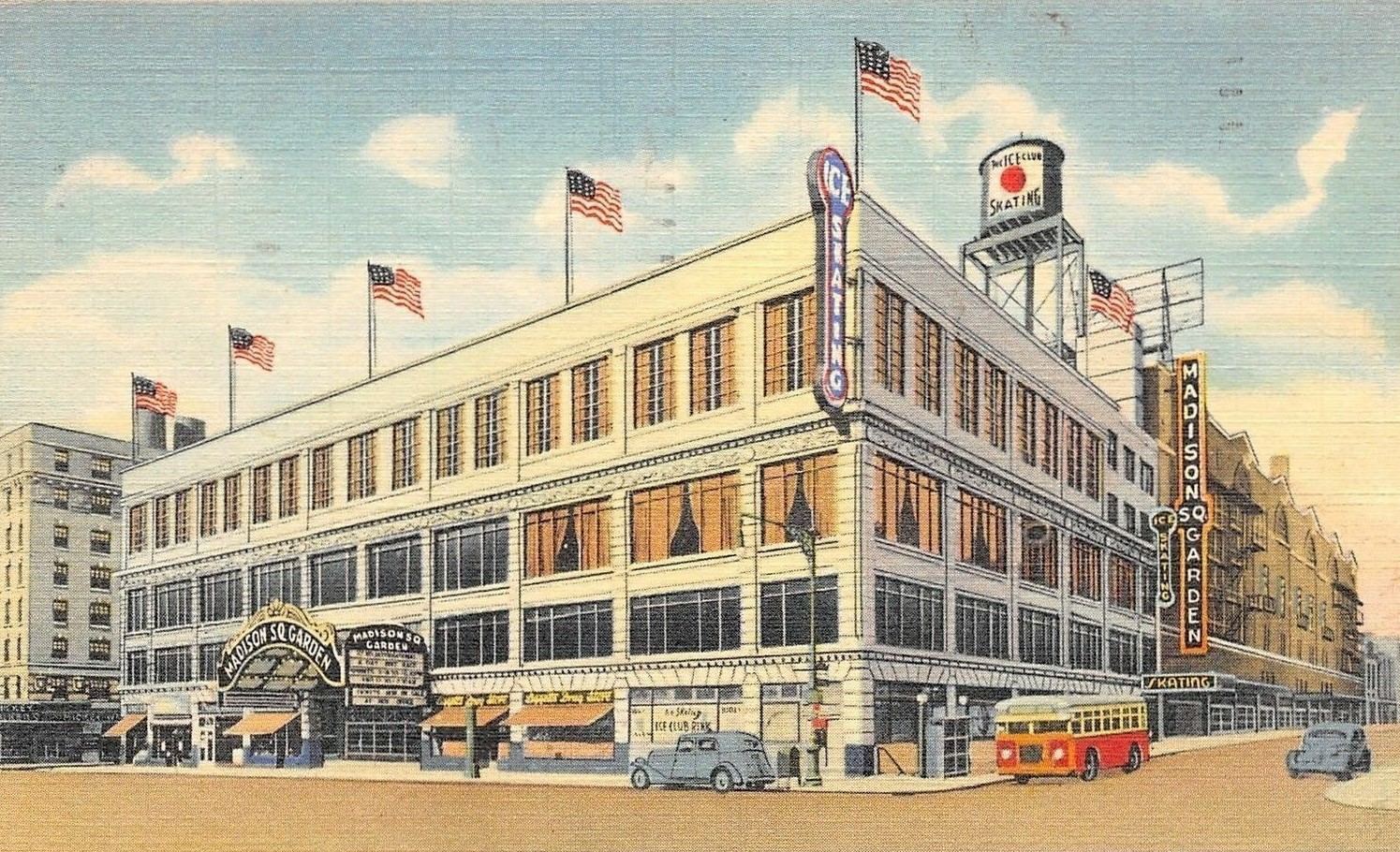
Postcard: Frank E. Cooper, 1941. Public domain.
The theory of dirt
Stillman's was famous for being filthy, and Stillman was proud of it. He let the floors go unwashed, sometimes for years, and kept the windows shut. The line he is remembered for, that the golden age of prizefighting was an age of bad food, bad air and no sunlight, and that if he cleaned the place up his fighters would catch cold from the cleanliness, has been repeated so often it belongs half to history and half to lore. Gene Tunney refused to train there unless the windows were opened. Stillman did not open the windows. Tunney trained elsewhere.
Plenty of others came anyway. Jack Dempsey, Georges Carpentier, Primo Carnera, Joe Louis, Rocky Marciano. The gym's reputation was simple. If you were serious and in New York, you were at Stillman's, and if you were a manager or a matchmaker, you went there to look. The third Madison Square Garden opened five blocks south in 1925 and made the walk between them one of the shortest commutes in sport.
Who was not welcome
In 1922 a French dancer named Jeanne Lamar showed up to train. Stillman told her there were "no facilities for girls." She stayed and trained anyway. It is a small story and a telling one. It took decades for New York gyms to make room for women in any formal way.
The end
Stillman sold the building in 1959. It was knocked down for an apartment building. He moved to California to be near his daughter, took up oil painting, and became good at it. He died in a nursing home in Santa Barbara on August 19, 1969.
Gleason's Gym, which outlasted it, still describes the 1960s as the decade when boxing lost two of its New York temples, Stillman's and the old Garden. Nothing at 919 Eighth Avenue marks where the gym stood. The best surviving pictures of it may be in the movies: Somebody Up There Likes Me, the 1956 Rocky Graziano film, and It's Always Fair Weather, which put Cyd Charisse in the gym for a musical number in 1955.
"Old Stillman, as this building is named in honor of the founder, is three stories high, covered with soot instead of ivy and probably older than most midwestern campuses at that."
The Record is the editorial desk of Kings County. Drafted from Liebling's 1955 reporting and published histories. Corrections and additions: write to the editors.
Sources
- A. J. Liebling, "Part I: The University of Eighth Avenue," Sports Illustrated, Dec. 5, 1955 (archived SI Vault): https://web.archive.org/web/20140305212540/www.cnnsi.com/vault/article/magazine/MAG1130508/index.htm
- Lou Stillman (biography, Geer and Mallison, name change, rules, Lamar, Tunney, retirement, death, films): https://en.wikipedia.org/wiki/Lou_Stillman
- Jeffrey Sussman, "Lou Stillman & His Famous Filthy Gym," PhilBoxing.com, Nov. 15, 2016 (919 Eighth Ave, 1959 demolition): https://philboxing.com/story-123917
- Gleason's Gym, "Gleason's History": https://www.gleasonsgym.com/gym-history