

Madison Square Garden has been four different buildings on two different sites, and only one of them sat anywhere near Madison Square. A walking history of the room New York calls the mecca, from a railroad shed on 26th Street to the roof over Penn Station.
If you want to stand where it started, go to the northeast corner of East 26th Street and Madison Avenue. There is nothing to see that says Garden. But in 1871 a small passenger depot of the New York and Harlem Railroad sat empty there after the railroad moved its operations uptown to the new Grand Central Depot on 42nd Street. The lot stayed vacant until 1874, when P. T. Barnum leased it and built a roofless oval he called the Great Roman Hippodrome.
I. The shed, 1879–1890
The space passed through a few hands. In 1876 the bandleader Patrick Gilmore took it over and named it Gilmore's Garden. He staged flower shows, revival meetings, walking races and the first Westminster dog show. He also staged boxing. Prizefighting was technically illegal, so the bouts were billed as "exhibitions," or, better, "illustrated lectures."
On May 31, 1879, William Kissam Vanderbilt, whose family owned the site, announced that the arena would be called Madison Square Garden. It seated about 10,000. In July 1882 John L. Sullivan began a series of exhibitions there that ran for four years and drew crowds bigger than the building could hold. The first Garden had a leaky roof and balconies that had collapsed with fatal results, and it came down in 1890.
II. Stanford White's tower, 1890–1925
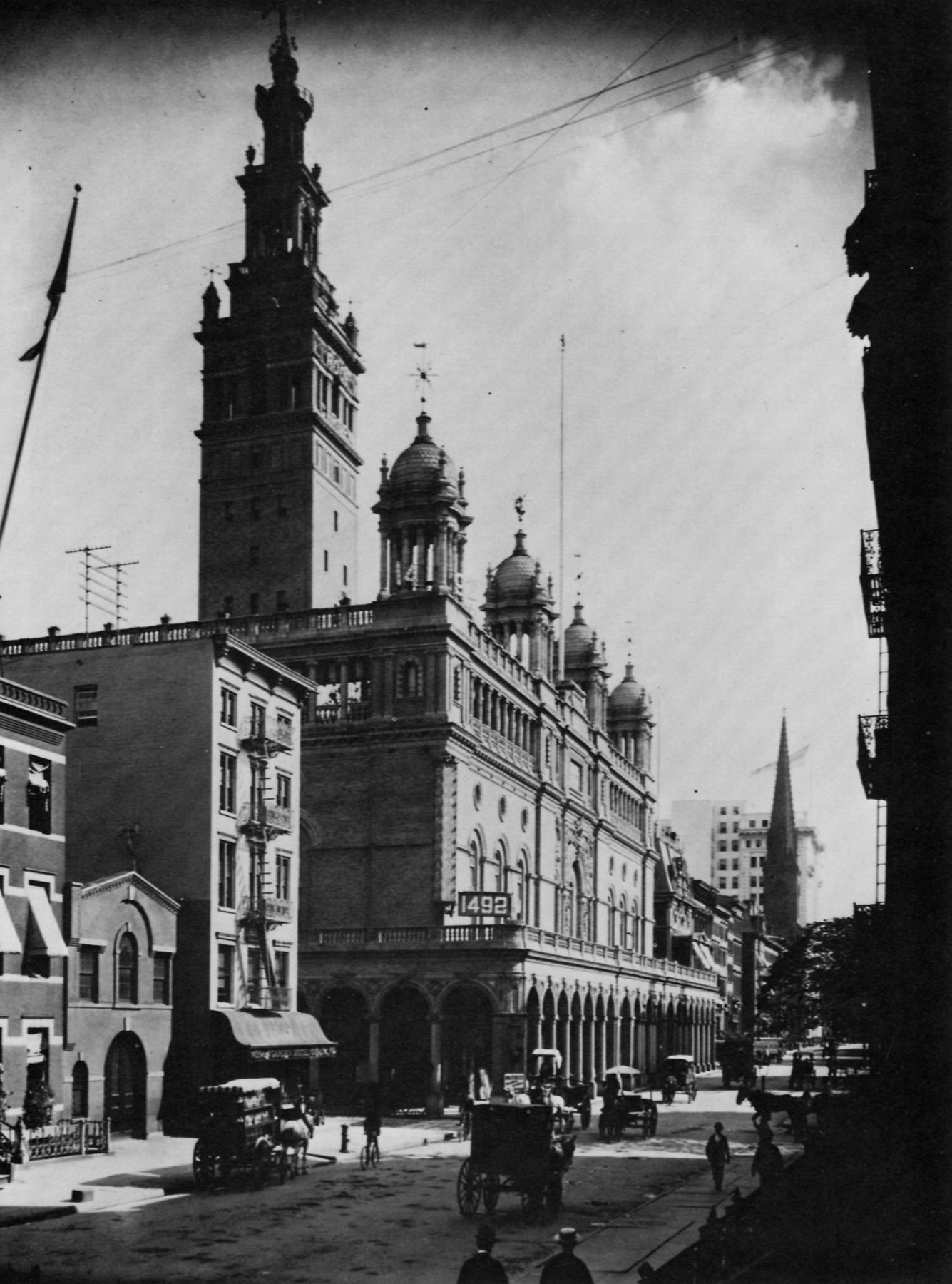
The second Garden went up on the same block and was a different order of building. It was designed by Stanford White, financed by a syndicate that included J. P. Morgan and Andrew Carnegie, and finished with a tower modeled on the Giralda in Seville, 32 stories at its crown, for a while the second-tallest structure in the city. At the top turned a gilded copper Diana by Augustus Saint-Gaudens. The main hall was the largest in the world, with permanent seating for 8,000 and floor room for thousands more. There was a theatre, a concert hall, a restaurant, and a roof garden cabaret.
On that roof, in 1906, the millionaire Harry Kendall Thaw shot White dead. In 1924 the Democratic National Convention met in the hall and needed 103 ballots to nominate John W. Davis. The building closed in 1925. The Diana survives, in a later version, at the Philadelphia Museum of Art.
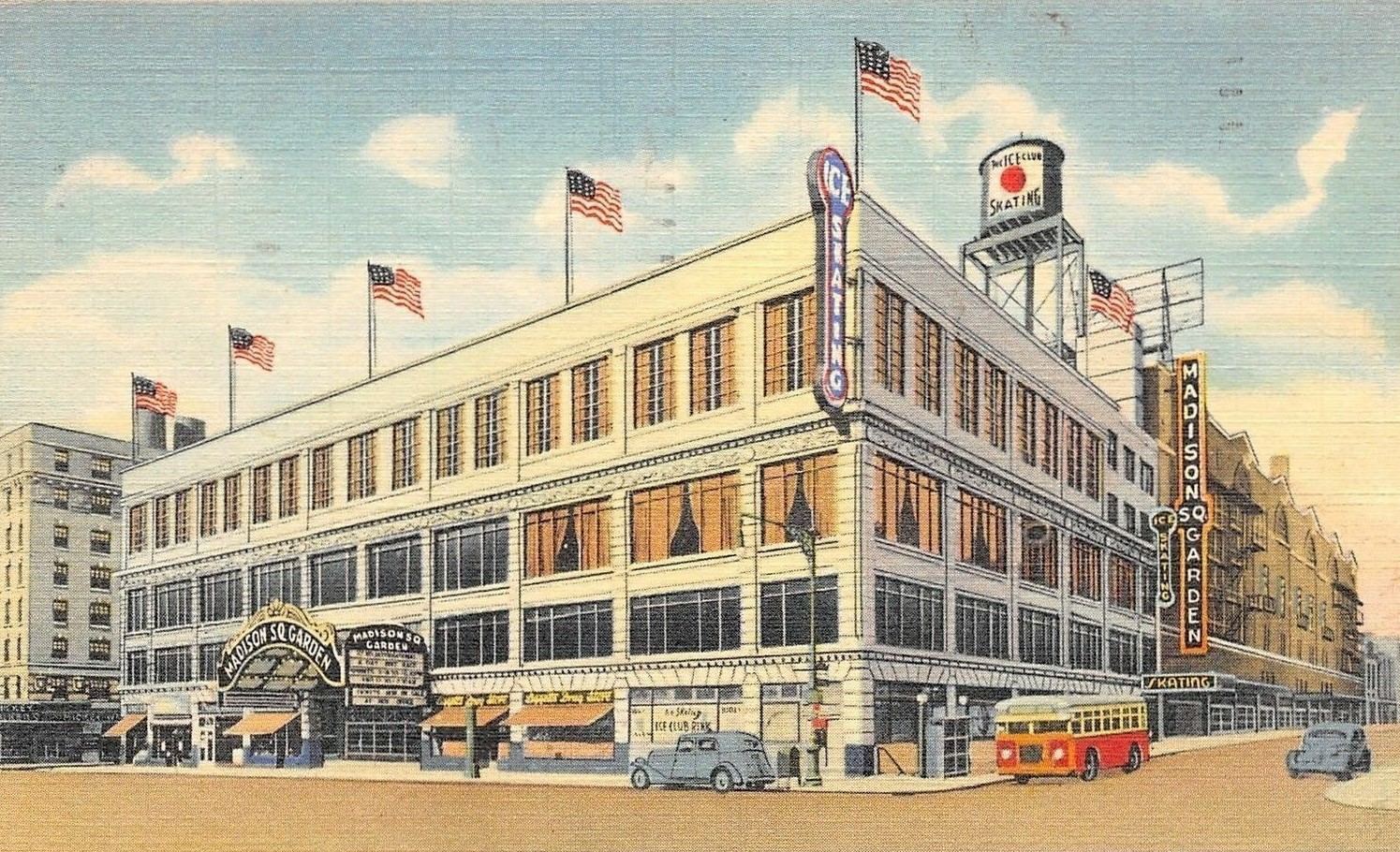
Postcard: Frank E. Cooper, 1941. Public domain.

III. Eighth Avenue, 1925–1968
The third Garden was the first to leave Madison Square, and it took the name with it. It went up on the west side of Eighth Avenue between 49th and 50th Streets, on the site of the city's trolley barns. The boxing promoter Tex Rickard built it in 349 days, with backers he liked to call his "600 millionaires." Ground was broken on January 9, 1925. A week before the official opening on December 15, more than 22,000 people watched Paul Berlenbach defend the light heavyweight title against Jack Delaney.
For boxing it held 18,496. It is the Garden most people mean when they talk about the old Garden: the marquee, the smoke, Friday nights on television. The Daily News Golden Gloves finals filled it. Emile Griffith and Benny Paret fought there in March 1962. José Torres won the light heavyweight title there in 1965, and that December the building held a night in honor of Sugar Ray Robinson. The Rangers were named there, as a pun on Rickard: Tex's Rangers.
The last Knicks game on Eighth Avenue was played on February 10, 1968. The building was demolished that year and into 1969. One Worldwide Plaza stands on the site.
IV. Over the tracks, 1968–
The fourth Garden opened on February 11, 1968, on top of what had been Pennsylvania Station. Demolition of McKim, Mead & White's station had begun in 1963. The outcry over losing it led directly to the creation of the city's Landmarks Preservation Commission, which is one of the stranger legacies a sports arena can claim.
Boxing in this building has its own short list. On December 7, 1970, Muhammad Ali fought Oscar Bonavena here in his first New York fight after the state restored his license. On March 8, 1971, he and Joe Frazier fought the Fight of the Century. Decades later, Miguel Cotto turned the night before the Puerto Rican Day Parade into a standing date on the calendar.
The argument over this Garden has never really stopped. In 2013 Manhattan Community Board 5 voted 36–0 against renewing its operating permit in perpetuity, proposing a ten-year limit so that a new station could be built. As of this writing the arena is still there and the station is still underneath it.
Walking it
You can do all four in an afternoon. Start at 26th and Madison. Walk west to Eighth and up to 50th for Rickard's Garden. Then come back down to 33rd, where the trains run under the arena. It is about three miles, and only the last stop has a box office.
"One entered the city like a god; one scuttles in now like a rat."
The Record is the editorial desk of Kings County. Drafted from published histories of the four buildings. Corrections and additions: write to the editors.
Sources
- Madison Square Garden (1879): https://en.wikipedia.org/wiki/Madison_Square_Garden_(1879)
- Madison Square Garden (1890): https://en.wikipedia.org/wiki/Madison_Square_Garden_(1890)
- Madison Square Garden (1925): https://en.wikipedia.org/wiki/Madison_Square_Garden_(1925)
- Madison Square Garden (current; Penn Station, Landmarks, Community Board 5 vote, Scully quote): https://en.wikipedia.org/wiki/Madison_Square_Garden
- Muhammad Ali v. Division of State Athletic Commission, 316 F. Supp. 1246 (S.D.N.Y. 1970): https://law.justia.com/cases/federal/district-courts/FSupp/316/1246/1951538/