
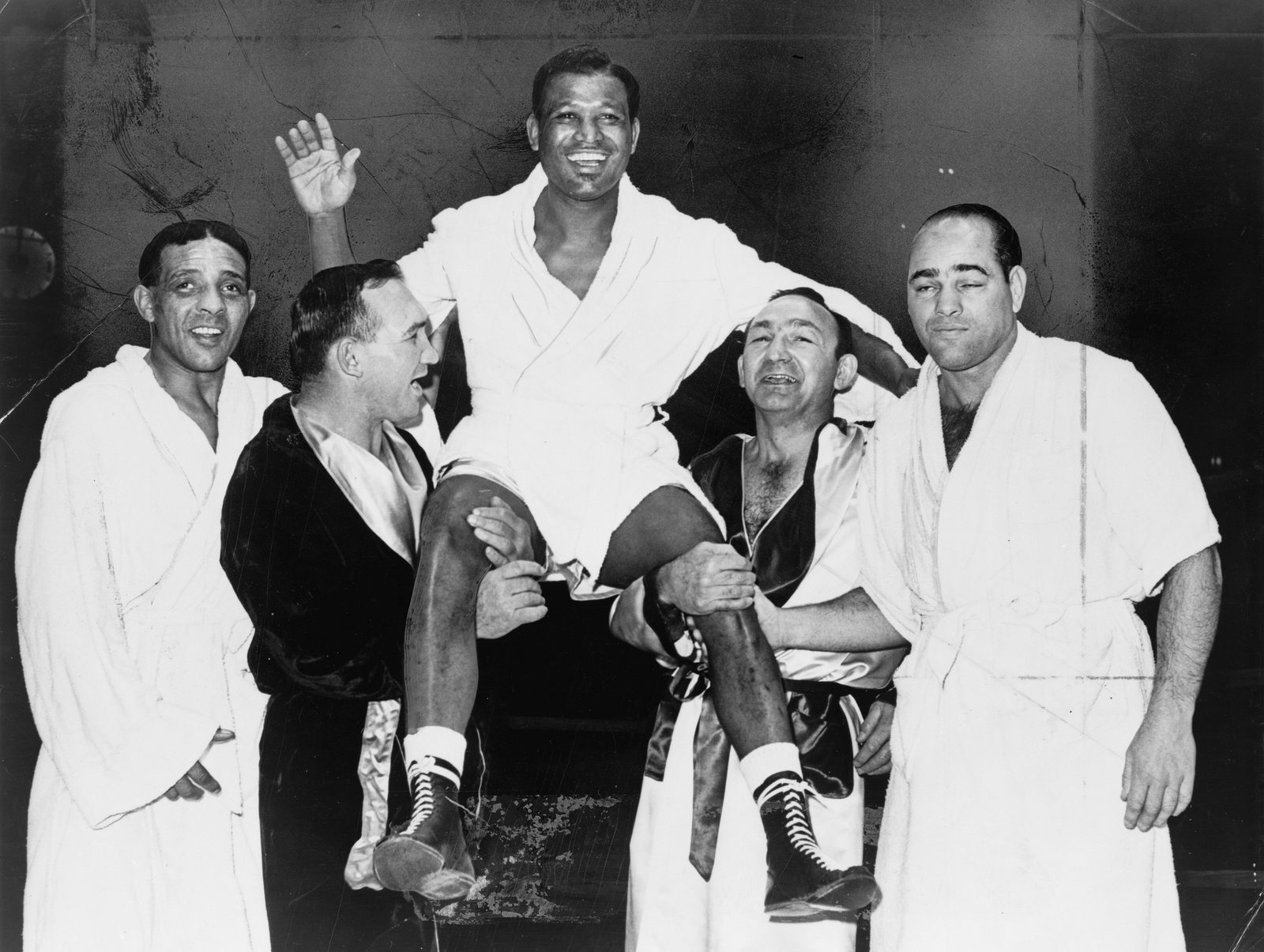

Between 123rd and 124th Streets on Seventh Avenue, Sugar Ray Robinson ran a barbershop, a cleaners, a lingerie shop and a nightclub while he was still the best fighter alive. The street has his name now. The storefronts have changed hands many times.
Start on the west side of Adam Clayton Powell Jr. Boulevard, which people of a certain age still call Seventh Avenue, and walk from 123rd Street up to 124th. Since May 2012 the signs on that stretch have also read Sugar Ray Robinson Way. From the mid-1940s into the early 1960s, the block was something close to his.
There was the Golden Gloves Barber Shop. There was Sugar Ray's Quality Cleaners, and Edna Mae's Lingerie Shop, named for his wife, Edna Mae Holly, who had danced at the Cotton Club. And there was Sugar Ray's, the restaurant and nightclub, where on a given night you might find Frank Sinatra, Nat King Cole, Lena Horne, Joe DiMaggio, Jackie Robinson, or Joe Louis, the fighter Robinson had idolized as a boy.
From Ailey to Harlem
He was born Walker Smith Jr. on May 3, 1921, in Ailey, Georgia. His father farmed cotton, peanuts and corn, then moved the family to Detroit for construction work. In Detroit, at eleven, the boy lived on the same block as a seventeen-year-old Joe Louis. When his parents separated, he came to Harlem with his mother. He was twelve.
He wanted at first to be a doctor. He dropped out of DeWitt Clinton High School in the ninth grade. The name came from a borrowed amateur card that belonged to another boy named Ray Robinson, and it stuck. The "Sugar" came later, according to the usual story, from a woman at a fight in Watertown, New York, who said he was sweet as sugar.
The amateur record is famously murky. The figure most often given is 85 wins and no losses with 69 knockouts, and it is disputed; there are reports that he lost as a teenager under his own name. What is certain is in the New York Golden Gloves books. He won the featherweight title in 1939, beating Louis Valentine over three rounds, and the lightweight title in 1940, stopping Andy Nonella in the second.
The business of looking like that
Robinson became a businessman while still fighting, which was unusual. Athletes of his era mostly opened a bar after they retired, if they opened anything. He opened a block.
He also understood that the way he looked was part of the job. His barber, Rogers Simon, worked at the Golden Gloves shop and was part of the entourage. Simon is credited, by Jet magazine in 1953 and by people who knew him, with a version of the straightened, set style that became Robinson's signature. Simon traveled with him and, according to a Harlem minister who was a lifelong friend of the fighter, would get up between rounds to put Robinson's hair back in place. The car was a flamingo-pink Cadillac. When Robinson went to Paris in 1951 the Cadillac went too.
It is easy to make this sound frivolous. It was not. A Black champion in the 1940s who presented himself as a man of means, on his own street, in his own shops, was making a claim about what Harlem was owed. Style was part of the work, which is something anyone who has thought hard about what to wear on fight night already knows.
There were limits, and some of them were written into law. After the war, Robinson and Louis planned to start a liquor distribution business in New York. They were denied a license because of their race.
The fights
He held the world welterweight title from 1946 to 1951. He fought Jake LaMotta six times and won five, finishing their rivalry on February 14, 1951, in Chicago by stopping LaMotta in the thirteenth round. That July he lost the middleweight title to Randolph Turpin in London. Two months later, at the Polo Grounds in upper Manhattan, before about 60,000 people, he stopped Turpin in the tenth, bleeding from a cut that threatened to end the fight. Harlem danced in the streets that night.
In June 1952, at Yankee Stadium, he challenged Joey Maxim for the light heavyweight title in temperatures recorded at 103 degrees in the ring. He was ahead on all three cards and could not answer the bell for the fourteenth round. It was the only time he was ever stopped.
After
By his own account Robinson was broke by 1965. He had earned about four million dollars in and out of the ring and spent it. His son, Ray Robinson Jr., said in 2012 that his father's manager had sued him and taken possession of the businesses. A month after his last fight, on December 10, 1965, Madison Square Garden held a Sugar Ray Robinson Night. He moved to Los Angeles, started a youth foundation there in 1969, and died on April 12, 1989. He was 67.
The block has been renamed and renamed again by the businesses on it. The sign at the corner is the one fixed thing.
"At one time my father owned the whole block."
The Record is the editorial desk of Kings County. Drafted from published histories and contemporary reporting. Corrections and additions: write to the editors.
Sources
- Sugar Ray Robinson, biography, Golden Gloves titles, LaMotta, Turpin, Maxim, liquor license denial, 1965 night, death: https://en.wikipedia.org/wiki/Sugar_Ray_Robinson
- Harlem World Magazine, "Harlem's Sugar Ray Robinson's Sweet Success," Aug. 1, 2012 (businesses, street co-naming, Ray Robinson Jr. quotes): https://www.harlemworldmagazine.com/harlems-sugar-ray-robinsons-sweet-success/
- Corey Kilgannon, "Once the King of Harlem Hairdressers, Now Nearly Forgotten," New York Times City Room, March 24, 2013 (Rogers Simon, Golden Gloves Barber Shop, Sugar Ray Robinson Way): https://archive.nytimes.com/cityroom.blogs.nytimes.com/2013/03/24/sugar-rays-barber/
- Sugar Ray Robinson with Dave Anderson, Sugar Ray (Viking, 1970)