
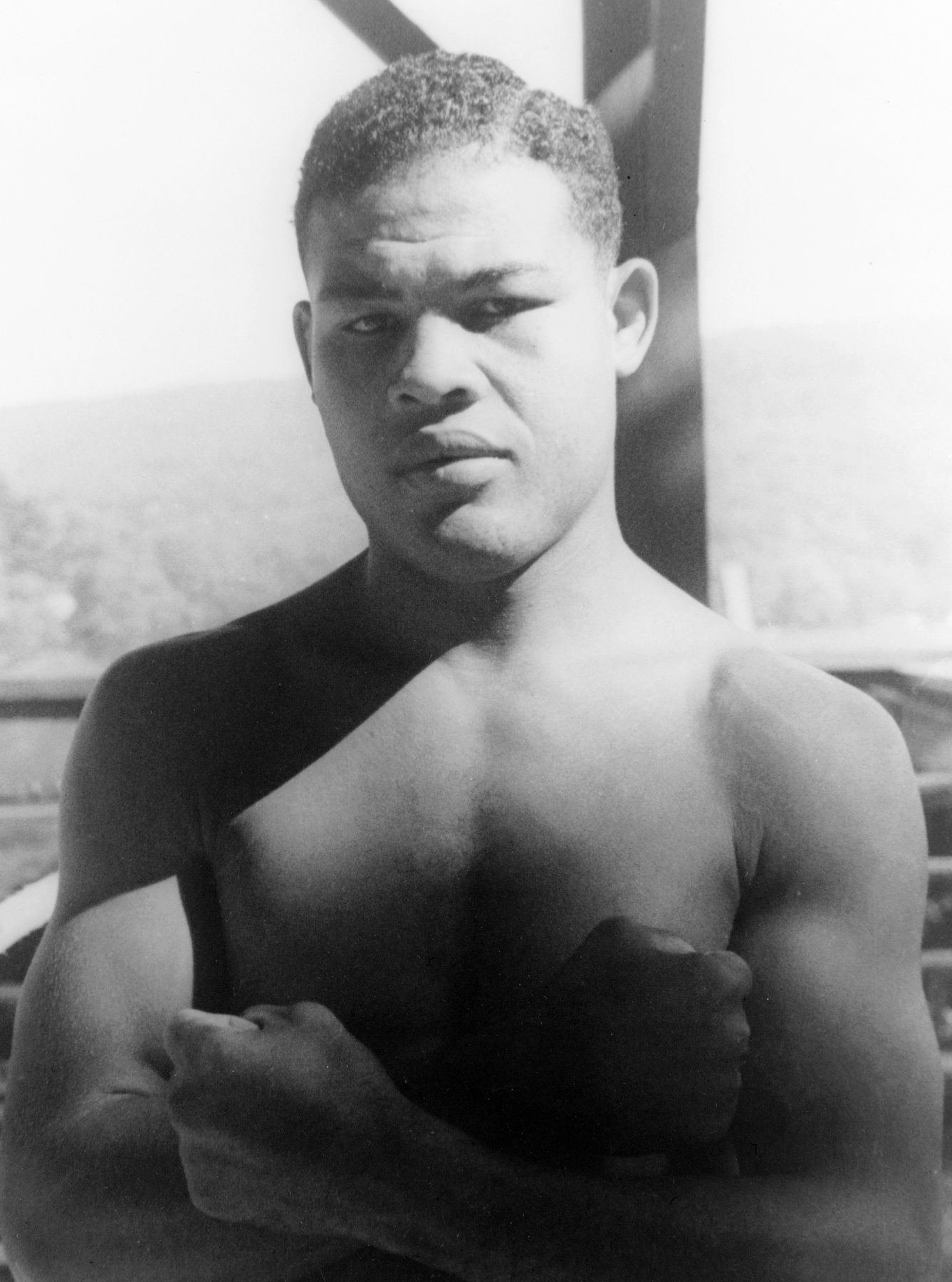

On June 22, 1938, in the Bronx, Joe Louis ended his rematch with Max Schmeling before most of the 70,000 people there had settled into their seats. What the fight meant was argued for years. What happened in the ring took 124 seconds.
Joe Louis took a two-hour nap. That detail survives in most accounts of the night, and it is worth starting there, because almost nothing else about June 22, 1938, was restful.
The rematch was set for Yankee Stadium, a year to the day after Louis had knocked out James J. Braddock in Chicago to become heavyweight champion. Louis had said afterward that he would not think of himself as champion until he fought Schmeling again. Two years earlier, on June 19, 1936, in the same stadium, Schmeling had knocked him out in the twelfth round. It was the only loss of Louis's young career, and it had been watched closely in Berlin.
Two men, many interpreters
By 1938 the fight belonged to other people. Germany had annexed Austria in March. The Nazi press presented Schmeling as proof of a racial theory. He had not asked for that role, and his own position was complicated. He was not a party member. He kept his Jewish manager, Joe Jacobs, under pressure to drop him. He is quoted as saying, "I am a fighter, not a politician." He also never gave up his German citizenship, and an official party publicist traveled with his camp, issuing statements that a Black man could not beat him. His wife and mother stayed home, which kept him from any thought of defecting.
On the American side, Louis was asked to carry a country that did not let him eat where he liked. A few weeks before the fight he visited the White House. The New York Times quoted President Roosevelt telling him, "Joe, we need muscles like yours to beat Germany." Louis wrote later that he knew he had to get Schmeling good, that he had his own reasons, and that the whole country was depending on him.
Some of what happened in the days before the fight was pure New York bureaucracy. The State Athletic Commission ruled that Jacobs could not work Schmeling's corner or enter the locker room, over an earlier publicity dispute involving the heavyweight Tony Galento. Schmeling's regular cornerman, Doc Casey, declined to work the fight. Schmeling sat in the dressing room with less help than he was used to. Louis slept.
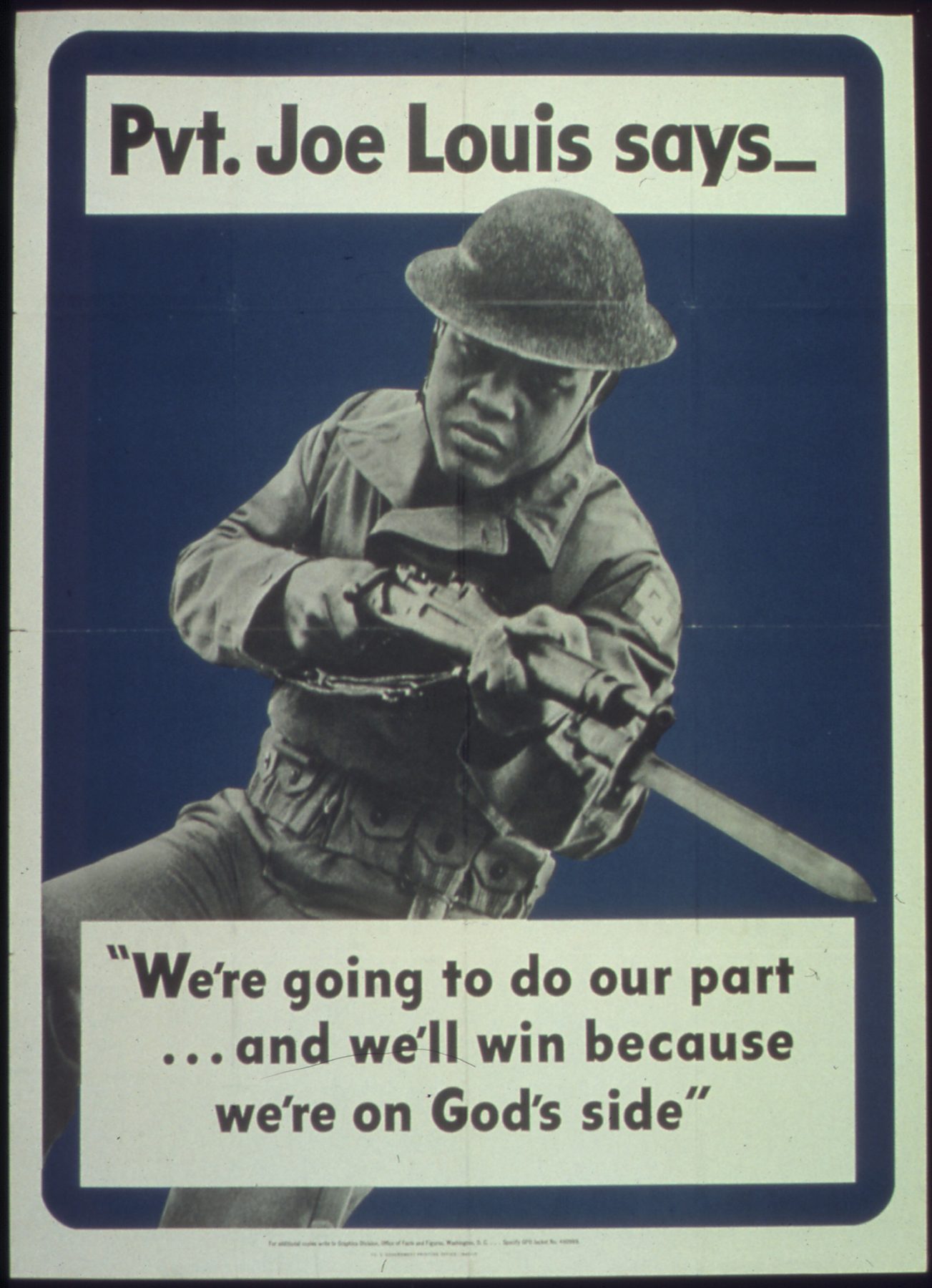
Poster: U.S. government, 1941 to 1945. U.S. National Archives, NAID 513548. Public domain.

The first round
The stadium was sold out, more than 70,000 people, with a gate of $1,015,012. About 70 million Americans listened on the radio. Hitler lifted the 3 a.m. curfew in Germany so bars and cafés could carry the broadcast.
Schmeling came out upright, left hand ready, planning to fight the way he had fought two years before. Louis had told his trainer, Jack "Chappie" Blackburn, that he would put everything into the first three rounds, and he had told the columnist Jimmy Cannon he expected a knockout in one.
He started almost at once. Referee Arthur Donovan stepped in after about a minute and a half, after a run of left hooks and a body shot that made Schmeling cry out. When action resumed, a right hook put Schmeling down. He was up at three. Louis went to the head. Schmeling went down again and rose at two. The third knockdown came near the center of the ring. Schmeling's cornerman Max Machon threw a towel, which under New York rules did not stop a fight, and then climbed into the ring at the count of eight. Donovan waved it off. The time was two minutes and four seconds of the first round.
Louis threw 41 punches and landed 31. Schmeling threw two.
Afterward
Schmeling spent ten days at Polyclinic Hospital, where doctors found cracked vertebrae in his back. His camp complained of an illegal kidney punch and never filed a formal protest.
In his autobiography, Schmeling remembered the ambulance ride uptown. As they drove through Harlem, he wrote, there were bands that had left the nightclubs to play on the sidewalks, and crowds dancing in the street, calling Louis's name.
The mainstream press praised Louis in language that showed what he was still up against. The Washington Post's account of the fight opened by calling him "the lethargic, chicken-eating young colored boy." Within four years Louis was in uniform, and the government was printing his words on recruiting posters.
The two men, for their part, became friends in later life. That friendship is documented, and it is also one of the parts of this story most often polished into a parable. The plainer record is enough: a fight that people in two countries had loaded with every meaning they could find, finished in a little over two minutes by a man who had slept well.
"We're going to do our part . . . and we'll win because we're on God's side."
The Record is the editorial desk of Kings County. Drafted from published histories and archival records. Corrections and additions: write to the editors.
Sources
- Joe Louis vs. Max Schmeling II, background, round-by-round, attendance, gate, radio audience, aftermath, Schmeling autobiography passage, Washington Post line: https://en.wikipedia.org/wiki/Joe_Louis_vs._Max_Schmeling_II
- National Archives, "Pvt. Joe Louis Says" poster, NAID 513548: https://catalog.archives.gov/id/513548
- Carl Van Vechten portrait of Joe Louis, 1941, LOC digital ID cph.3c09776, via Wikimedia Commons: https://commons.wikimedia.org/wiki/File:Joe_Louis_by_van_Vechten.jpg
- National WWII Museum, "Joe Louis: From Boxing Gloves to Combat Boots" (Navy Relief dinner, March 10, 1942): https://www.nationalww2museum.org/war/articles/joe-louis-boxing
- David Margolick, Beyond Glory: Joe Louis vs. Max Schmeling, and a World on the Brink (Knopf, 2005)
- Max Schmeling, Max Schmeling: An Autobiography (Bonus Books, 1998)