
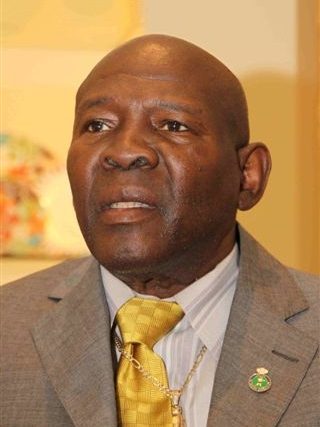
Emile Griffith won world titles in three divisions and fought more than a hundred professional bouts. One night at the Garden in 1962 followed him for the rest of his life, and so did a question he answered on his own terms, late.
The story usually starts at the hat maker's, and it should. Griffith came to New York from the Virgin Islands and, as a teenager, went to work for a hat maker. On a hot day he asked the owner if he could work with his shirt off. The owner, a former amateur boxer, said yes, looked at the young man's shoulders, and walked him over to the trainer Gil Clancy.
Griffith trained at the Parks Department gym on West 28th Street. In 1957 he reached the finals of the 147-pound sub-novice division of the New York Golden Gloves and lost. In 1958 he came back and won the 147-pound open title. He turned professional that year and fought often, mostly in New York.
Paret
He won the world welterweight title on April 1, 1961, knocking out Benny "Kid" Paret of Cuba in the thirteenth round. Six months later Paret took it back on a split decision. The third fight was set for March 24, 1962, at Madison Square Garden, on national television on ABC.
At the weigh-in, Paret touched Griffith from behind and called him "maricón," a Spanish slur for a gay man. Griffith had to be held back. The newspapers of the day either left the word out or used a euphemism. His girlfriend asked him about it afterward.
In the sixth round Paret nearly stopped him, and the bell saved him. Clancy told him in the corner to keep punching on the inside until Paret held or the referee broke them. In the twelfth round Griffith trapped Paret against the ropes and hit him again and again before the referee stepped in. Paret did not regain consciousness. He died ten days later. He was a young man with a family.
After the fight Griffith said on television that he hoped Paret was feeling good. When he understood what had happened he went to the hospital and tried for hours to get into Paret's room. He was turned away. People shouted at him in the street. He received hate mail from people convinced he had meant to kill. Governor Nelson Rockefeller appointed a seven-member commission to look into the fight and into boxing itself.
The long career after
Griffith fought for fifteen more years. He fought eighty more times and scored only twelve knockouts. He said later that he held back, that he was afraid of hurting someone that way again, and relied on boxing skill instead. He was named Fighter of the Year by The Ring and the Boxing Writers Association in 1963 and 1964. On April 25, 1966, he beat Dick Tiger over fifteen rounds for the middleweight title. He lost it, won it back and lost it again in three fights with Nino Benvenuti. He fought Carlos Monzón and José Nápoles. He retired in 1977 with a record of 85 wins, 24 losses and 2 draws.
He trained other fighters, including the Puerto Rican champions Wilfred Benítez and Juan Laporte, and coached the Danish Olympic team in 1979 and 1980. He worked as a corrections officer at a juvenile detention center in Secaucus. He lived for years in Weehawken, across the river.
In 1992, after leaving a gay bar near the Port Authority Bus Terminal, he was beaten so badly that he spent four months in the hospital. Whether the attack was motivated by homophobia was never established.
In his own words
Late in life Griffith spoke about his sexuality directly, and on his own terms. He told Sports Illustrated that he liked men and women both and did not like the labels people wanted to put on him. To his biographer Ron Ross he said the sentence that has become the most quoted thing about him, set below.
He suffered from dementia in his final years and needed full-time care, which came from Luis Rodrigo Griffith, his partner, whom he had adopted as a son. He died on July 23, 2013, at a care facility in Hempstead, Long Island. He was buried at St. Michael's Cemetery in Queens. He had been inducted into the International Boxing Hall of Fame with its first class, in 1990.
His life has since been told in the 2005 documentary Ring of Fire and in an opera. The hat maker's is in all of the versions, a shirtless kid on a hot afternoon, which is where his boxing life began.
"I keep thinking how strange it is . . . I kill a man and most people understand and forgive me. However, I love a man, and to so many people this is an unforgivable sin; this makes me an evil person."
The Record is the editorial desk of Kings County. This piece concerns a death in the ring and is published without any product content. Corrections and additions: write to the editors.
Sources
- Emile Griffith, biography, amateur titles, Paret fights, career, personal life, death: https://en.wikipedia.org/wiki/Emile_Griffith
- ESPN, "When the cost of a championship is a man's life" (Ross quote): https://www.espn.com/boxing/story/_/id/36135621
- Outsports, "Boxer Emile Griffith comes out as gay," May 30, 2008: https://www.outsports.com/2008/5/30/4045762/boxer-emile-griffith-comes-out-as-gay/
- Ron Ross, Nine . . . Ten . . . and Out! The Two Worlds of Emile Griffith (DiBella Entertainment, 2008)
- Dan Klores and Ron Berger, Ring of Fire: The Emile Griffith Story (2005 documentary)
- Donald McRae, A Man's World: The Double Life of Emile Griffith (Simon & Schuster, 2015)